Restorative Systems Framework
Understanding harm. Responding well. Building organizations people can trust.
A research-based model equipping leaders to understand trauma, respond to harm, and build psychologically safe, relationally healthy organizations, personally and systemically.
Developed through doctoral study at Liberty University. Currently in academic review, with an institutional pilot planned for spring 2027.
The Restorative Systems Framework is in academic review, with an institutional pilot planned for spring 2027. Churches can begin today through Sanctuary Certified™, available now.
Most organizations aren't unsafe on purpose.
They're often operating without a clear understanding of how harm shows up, or a shared framework for responding to it.
Leaders are navigating complex human dynamics without always having the tools or shared language to fully understand them. When challenges arise, whether emotional, psychological, or relational, organizations can unintentionally cause more harm, not less.
The result isn't always obvious. But over time it leads to confusion, misalignment, and erosion of trust across the system.
What's needed isn't more pressure or intention. It's clarity, structure, and a shared framework.
Mislabeling or overlooking what's actually happening beneath the surface
Responding inconsistently across teams and leadership levels
Relying on policies that don't fully address the human situation
Creating environments where people are unsure whether, or how, to speak up
Investing in training without the structure to make it stick
"Insight without structure doesn't create change. The Restorative Systems Framework gives leaders both."
A clear framework for understanding people, responding well, and building aligned systems.
The Restorative Systems Framework gives leaders a shared way to navigate complexity, lead with clarity, and create consistency across their organization, from the individual leader all the way through the entire system.
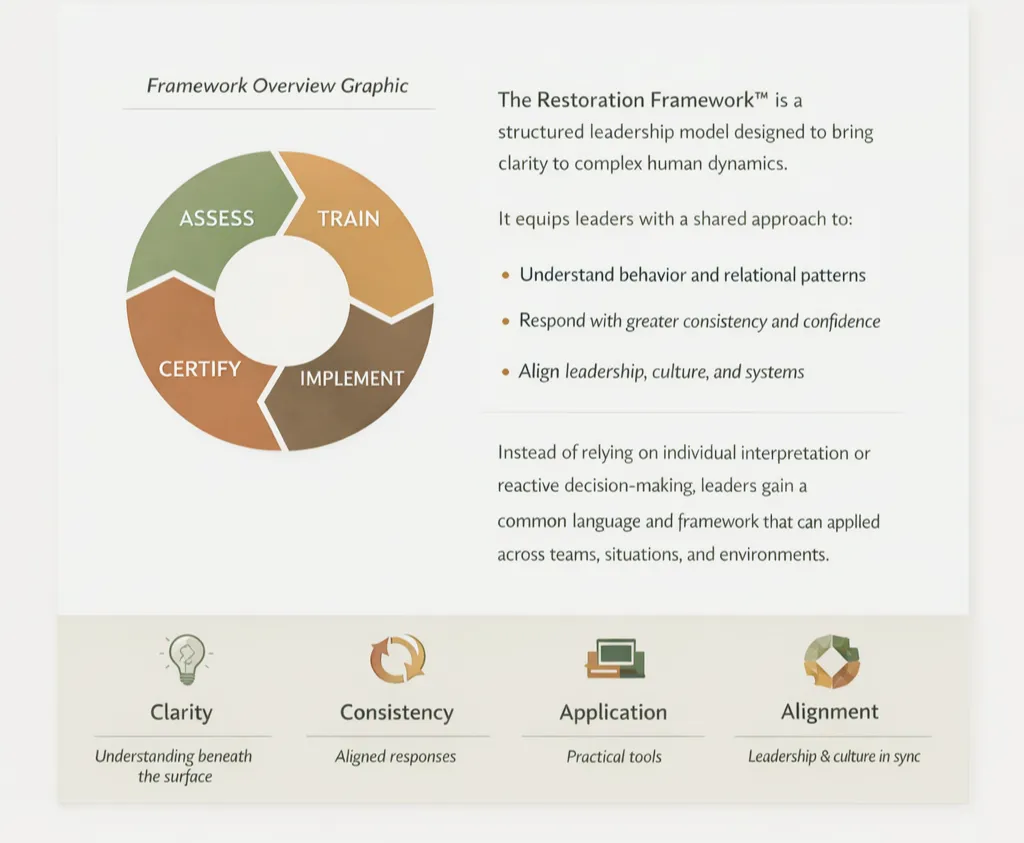
The Restorative Systems Framework is a research-based model developed through doctoral work in trauma-informed leadership and organizational systems. This isn't about adding more to what leaders are already carrying. It's about giving them a clearer way to lead what's already in front of them.
A structured pathway for real, measurable transformation.
The Restorative Systems Framework moves leaders and organizations through a clear, four-phase process designed to create alignment, consistency, and lasting change. Each phase builds on the next, ensuring insight doesn't stay theoretical and implementation doesn't stay inconsistent.
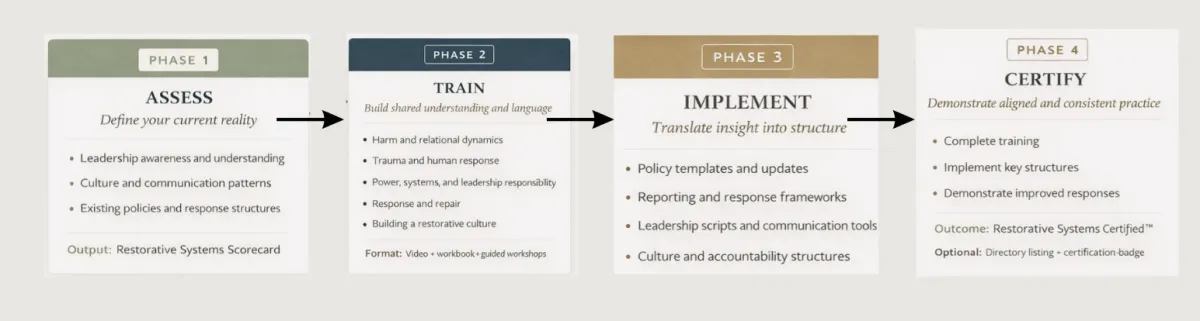
This is more than training. It's a system.
Leaders gain a structured way to lead, respond, and build organizations that work.
Each phase builds, so change doesn't depend on individuals. It's built into how the organization operates.
Most leadership training informs. This framework transforms.
The Restorative Systems Framework goes beyond awareness to create alignment across people, leadership, and systems. Most approaches stop at education. This one doesn't stop until change is built into how the organization actually operates.
Most organizations struggle because harm is misunderstood or inconsistently defined. Leaders can't respond well to what they can't name clearly.
Leaders don't need to become therapists to lead well. They need trauma concepts translated into practical leadership insight they can actually apply.
Most programs stop at education. That's where this one starts going deeper, into the policies, structures, and systems that determine how the organization actually functions.
Without accountability, training fades. This model includes measurable standards and certification, making follow-through demonstrated rather than merely intended.

"Insight becomes action. Action becomes structure. Structure becomes culture."
This is where most approaches fall short, and where the Restorative Systems Framework goes further.
What changes when leaders and systems are aligned.
The Restorative Systems Framework doesn't just increase awareness. It creates measurable shifts in how organizations understand, respond, and operate.
Completed leadership training across all core modules
Organizational assessment and Restorative Systems Scorecard
Updated policies, reporting structures, and response frameworks
Shared language and alignment across leadership
Increased clarity and confidence among leaders at every level
More consistent and effective responses to complex challenges
Greater psychological safety across teams and environments
Stronger trust within organizations and the communities they serve
Healthier, more sustainable organizational culture
Reduced relational and systemic harm over time
Designed for leaders responsible for people, culture, and systems.
If you lead people, shape culture, or influence systems, this framework is built for you.
Leaders responsible for organizational culture, employee wellbeing, and building teams that function with trust and psychological safety.
Pastors, elders, and ministry leaders committed to creating genuinely safe, trauma-informed faith communities, not just well-intentioned ones. Available now through Sanctuary Certified™.
Mission-driven organizations serving vulnerable populations who need their internal culture to match the care they extend outward.
School administrators, program directors, and curriculum leaders building learning environments grounded in safety, dignity, and care.
Teams experiencing growth, transition, conflict, or cultural challenges who need a clear, structured pathway through to the other side.
The people responsible for how organizations treat their people, who want a framework that goes beyond compliance to genuine organizational health.
The church pathway is already open: Sanctuary Certified™
For churches and faith-based organizations, the Restorative Systems Framework has been developed into a separate curriculum built entirely for ministry contexts: the Sanctuary Certified™ pathway, a biblically grounded, trauma-informed approach to creating genuinely safe and healthy church environments.
Unlike the organizational framework, this pathway is finished and enrolling today. It ensures churches are not only well-intentioned but equipped, aware, and accountable, with clear standards and a forthcoming directory connecting people to trusted, certified communities.
An eight-module theologically integrated curriculum for church leadership
Guidance for responding to harm within ministry contexts
Safeguarding and mandatory reporting standards verified against current Texas law
Clear Safe Church certification standards and accountability
A forthcoming Safe Church Directory connecting communities with certified churches
Churches that are equipped, not just well-meaning.
The Sanctuary Certified™ pathway gives churches the tools, training, and accountability to become the kind of community people can actually trust, especially those who have been hurt by the church before.
Enroll Your ChurchPart of the Safe Church Project™, the church expression of the Restorative Systems Framework, developed as a distinct curriculum for ministry contexts.
Built at the intersection of research, leadership, and real-world application.
Grounded in doctoral research in trauma-informed leadership and organizational systems. Not trend-driven content, but rigorously developed frameworks.
Tested and refined through direct work in organizational and group settings, designed to function in the real complexity of actual organizations.
Grounded in the belief that every person carries inherent dignity, that restoration is possible, and that organizations have a responsibility to embody that conviction.
"This work bridges the gap between what leaders are taught and what they are actually facing."
The Restorative Systems Framework is a research-based model developed through doctoral work in trauma-informed leadership and organizational systems. It integrates academic research in leadership and trauma, practical application in organizational settings, and faith-informed principles of dignity, responsibility, and restoration.
This is not a program built from trends or theory alone. It is built from the lived intersection of research, practice, and conviction, developed specifically to address what leaders face in real organizations, real churches, and real communities.
The Restorative Systems Framework is currently in academic review as part of doctoral study at Liberty University. An institutional pilot is planned for spring 2027, with general availability to follow. Join the notification list below and we will let you know when it opens.
The research this model is built on.
The Restorative Systems Framework is not assembled from trends. It draws on established trauma scholarship, the literature on institutional and organizational harm, and a theological account of human dignity. These are the voices the framework is in conversation with.
Staged recovery, and why safety has to be established before anything else becomes possible.
Regulate, relate, reason. Why sequence governs whether an interaction helps or harms.
How trauma is carried in the body, not only in memory or belief.
Integration and attunement, and what makes a relationship regulating rather than activating.
Power, and what happens to it in the absence of accountability and humility.
How organizations reshape the story of harm in order to protect their own image.
How one leader's relational patterns quietly become an entire institution's norm.
The difference between a culture that protects itself and one that protects people.
The imago Dei, and what inherent dignity requires of the systems people live inside.
The neuroscience of being known, and where healing actually takes place.
The structural spine of the framework's movement from safety, through restoration, into reconnection.
Developed through doctoral study in Christian Leadership at Liberty University. Full citations appear in the dissertation, Developing a Trauma-Informed Leadership Training Model: A Transformational Leadership Approach to Addressing Organizational Responses to Trauma.
Be the first to know when it opens.
If you're responsible for people, culture, or leadership, this framework will change how your organization understands, responds, and operates. The organizational program is not yet open, and we would rather tell you honestly than take your time now.
Add your name and we will notify you when the Restorative Systems Framework becomes available. If you lead a church, the Sanctuary Certified™ pathway is open today and you do not need to wait.
Tell us where to reach you and we will be in touch when the organizational program opens.
"If you lead people, shape culture, or influence systems, this framework is built for you."